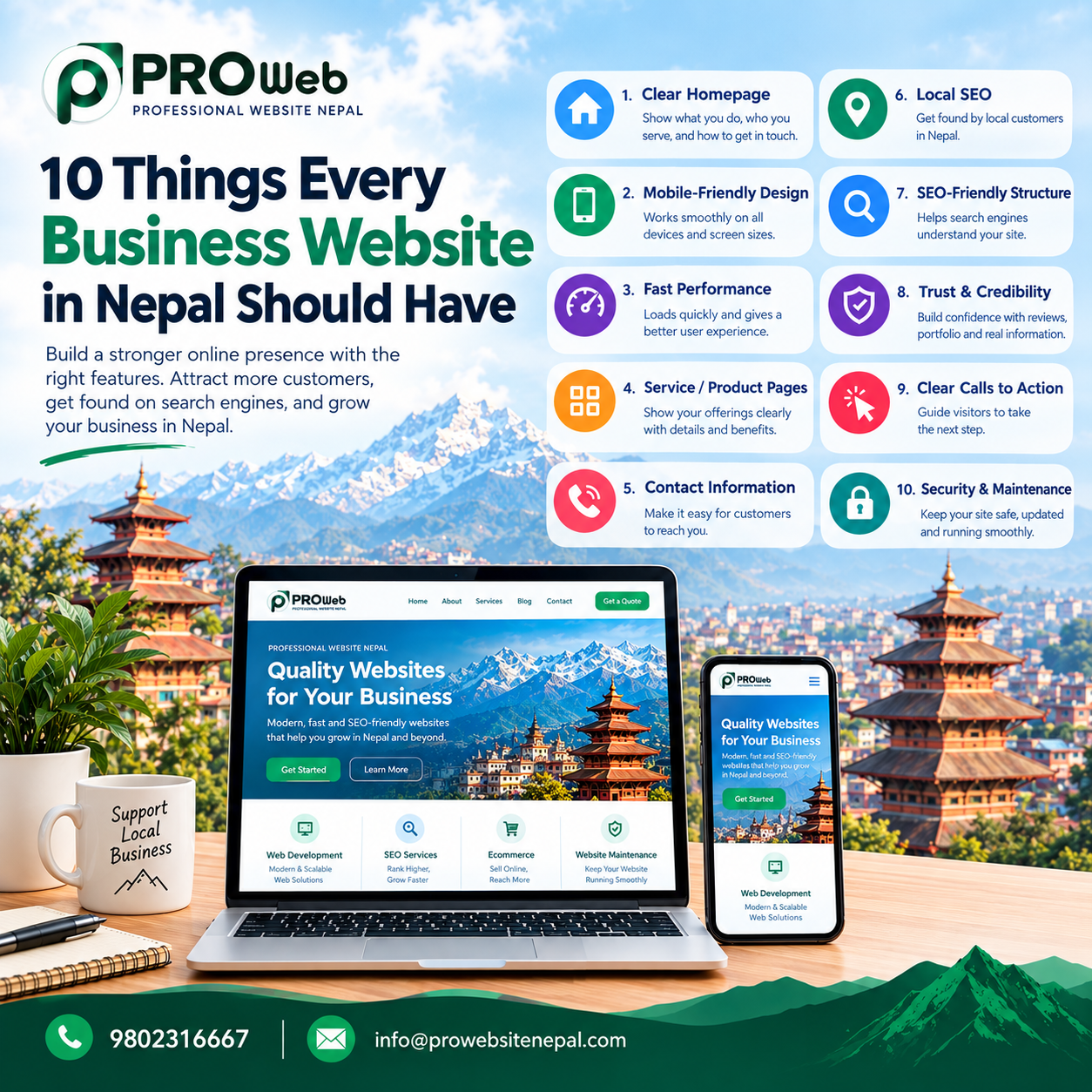
10 Things Every Business Website in Nepal Should Have
A business website is one of the most important digital assets a company can have. For businesses in Nepal, a website can help introduce services, build credibility, generate inquiries, attract customers from search engines, and provide information to people across different cities and locations.
However, simply having a website is not enough.
A modern business website needs to be fast, mobile-friendly, easy to navigate, trustworthy, search-engine-friendly, and focused on helping visitors take meaningful actions.
Whether you run a startup in Kathmandu, a hotel in Pokhara, a consulting company in Lalitpur, an ecommerce business, an NGO, or an established company serving customers throughout Nepal, there are several essential elements your website should include.
Here are 10 things every business website in Nepal should have.
1. A Clear Homepage
The homepage is often the first page visitors see.
Within a few seconds, visitors should be able to understand:
What your business does
Who you serve
What products or services you provide
Why customers should consider your business
How they can contact you
A strong homepage should not force visitors to search through multiple pages to understand what the company offers.
Important Homepage Elements
A business homepage can include:
Clear headline
Short business introduction
Primary services or products
Key benefits
Call-to-action buttons
Trust signals
Testimonials
Important company information
Contact information
Links to important pages
The goal is clarity.
Instead of filling the homepage with excessive text, businesses should organize information so visitors can quickly understand the company and continue exploring.
2. Mobile-Friendly Design
A modern business website must work properly on smartphones and tablets.
Visitors may access a website using:
Android phones
iPhones
Tablets
Laptops
Desktop computers
A website designed only for desktop screens can create a poor experience for mobile visitors.
A responsive website automatically adapts its layout to different screen sizes.
Mobile-friendly websites should provide:
Readable text
Easy navigation
Properly sized buttons
Responsive images
Fast loading
Accessible forms
Proper spacing
Mobile-friendly menus
Mobile optimization is also important for SEO. Google uses mobile-first indexing, meaning the mobile version of a site is generally the version used for indexing and ranking. Businesses should therefore treat mobile performance as a core part of website development.
3. Fast Website Performance
Website speed can influence how visitors experience a business website.
A slow website can make it harder for visitors to:
Read information
Browse services
View products
Submit forms
Navigate pages
Complete purchases
Performance is also connected to Google's page experience systems and Core Web Vitals.
Important performance metrics include:
Largest Contentful Paint (LCP)
Interaction to Next Paint (INP)
Cumulative Layout Shift (CLS)
Businesses should pay attention to:
Image optimization
Server response time
CSS
JavaScript
Caching
Hosting
Third-party scripts
Mobile performance
Google states that Core Web Vitals are used by ranking systems, but good scores alone do not guarantee high search rankings. Performance should therefore be considered as part of a broader SEO and user-experience strategy.
4. Clear Services or Product Pages
Visitors should not have to guess what your business offers.
Every major service or product should have a clear page where appropriate.
For example, a digital agency might have separate pages for:
Website Development
Ecommerce Development
SEO
Website Maintenance
Web Applications
A construction company might have pages for:
Residential Construction
Commercial Construction
Interior Design
Renovation
Project Management
Dedicated pages make it easier for visitors to understand individual offerings.
They can also create additional opportunities for search engines to understand what the business provides.
A good service page can include:
Service name
Description
Benefits
Process
Features
Relevant images
FAQs
Related services
Call-to-action
Contact information
5. Strong Contact Information
A business website should make contacting the company easy.
Important contact information can include:
Phone number
Email address
Physical address
Business hours
Contact form
Social media profiles
Map location where appropriate
For businesses operating locally in Nepal, providing accurate business information can be particularly useful for customers looking for nearby services.
Google's LocalBusiness structured-data documentation recommends providing relevant business details such as name, address, telephone number, URL, and other applicable information.
Make Contact Information Easy to Find
Important contact details can appear in:
Header
Contact page
Footer
Service pages
Homepage
Mobile navigation
Visitors should not have to search through the entire website to find a phone number or email address.
6. Strong Local SEO
For many Nepali businesses, local visibility is extremely important.
A business serving customers in Kathmandu may want to appear when people search for relevant services in Kathmandu.
Similarly, businesses may target locations such as:
Lalitpur
Bhaktapur
Pokhara
Biratnagar
Bharatpur
Butwal
Dharan
Chitwan
Other cities and regions
Local SEO helps businesses make their location and services clearer to both users and search engines.
Important Local SEO Elements
A business website can include:
Accurate business name
Address
Phone number
Business hours
Location information
Service areas
Location-specific pages where genuinely useful
Google Business Profile
Relevant structured data
Consistent business information
Google recommends using appropriate structured data to help it understand organization and local business information.
However, businesses should avoid creating dozens of low-quality location pages simply to target keywords.
Location pages should provide genuinely useful information.
7. SEO-Friendly Website Structure
A business website should be built so search engines can efficiently discover and understand its content.
This includes both technical structure and content organization.
Important SEO elements include:
Descriptive page titles
Useful meta descriptions
Clean URLs
Proper heading structure
Internal links
XML sitemap
Crawlable navigation
Canonical URLs where necessary
Proper indexing controls
Optimized images
Mobile-friendly pages
HTTPS
Search engines need to understand the relationship between different pages on your website.
For example:
Homepage → Services → Website Development → Ecommerce Development
A clear structure can help users navigate the website while also providing search engines with useful context.
8. Trust and Credibility
People need a reason to trust a business before contacting or purchasing from it.
Your website should communicate credibility clearly.
Depending on the type of business, useful trust elements may include:
About Us page
Company history
Team information
Client testimonials
Case studies
Portfolio
Certifications
Industry memberships
Business registration information where appropriate
Awards
Project results
Physical location
Clear contact details
Trust signals should be genuine.
Businesses should not add fake testimonials, fabricated certifications, or misleading claims simply to make the website appear more established.
A professional website should make it easy for potential customers to understand who is behind the business.
9. Clear Calls to Action
A business website should guide visitors toward useful actions.
A visitor may want to:
Request a quotation
Call the business
Send an inquiry
Book an appointment
Purchase a product
Request a consultation
Download information
Visit a physical location
These actions should be easy to find.
Examples of Calls to Action
Buttons might include:
Get a Quote
Contact Us
Request a Consultation
Call Now
View Services
Shop Now
Book an Appointment
Learn More
The appropriate CTA depends on the business.
A website should not place dozens of competing buttons everywhere.
Instead, it should guide visitors toward the most useful next step.
10. Security, Privacy and Reliable Maintenance
A business website should be maintained after launch.
Website development is not necessarily the end of the project.
Websites require ongoing attention to:
Security
Backups
Software updates
Performance
Broken links
Forms
Domain
Hosting
SSL certificate
Content
Technical SEO
Analytics
Website functionality
HTTPS should be enabled across the website.
Businesses should also have appropriate backup and recovery processes so that important website information can be restored if something goes wrong.
Website Maintenance Can Include:
Security monitoring
Backup management
Software updates
Bug fixes
Performance optimization
Content updates
SEO monitoring
Uptime monitoring
Hosting management
A website that was professionally built but never maintained can eventually develop technical and security problems.
Bonus: Analytics and Search Monitoring
Although the ten elements above cover the core requirements, businesses should also consider website analytics and search monitoring.
Tools such as Google Analytics and Google Search Console can provide useful information about website performance and search visibility.
Businesses can monitor:
Website traffic
Popular pages
Search queries
Clicks
Impressions
Technical issues
Indexing
User behavior
Conversion activity
Monitoring helps businesses understand what is happening after a website launches.
Without measurement, it can be difficult to know which pages attract visitors or where improvements are needed.
What Makes a Good Business Website in Nepal?
A good business website should bring together several different areas.
Design
The website should look professional and reflect the company's brand.
Performance
Pages should load efficiently and respond properly across devices.
SEO
Search engines should be able to crawl, understand, and index important content.
Content
Visitors should find useful and accurate information.
Trust
The website should clearly communicate who the business is and why customers can trust it.
Conversion
Visitors should have clear paths toward contacting, purchasing, booking, or requesting information.
Security
The website should be protected and maintained appropriately.
These elements work together.
A beautiful website with poor performance may frustrate users.
A fast website with poor content may fail to communicate the company's value.
A website with good content but confusing navigation may lose potential customers.
The strongest business websites consider all of these areas together.
Website Features for Different Types of Nepali Businesses
Not every business needs exactly the same website.
The requirements depend on the business model.
Service Businesses
Service companies may need:
Service pages
Contact forms
Testimonials
Portfolio
Case studies
Appointment requests
Location information
Ecommerce Businesses
Ecommerce websites may need:
Product catalog
Search
Filters
Shopping cart
Checkout
Payment gateways
Delivery information
Customer accounts
Inventory management
Hotels and Tourism Businesses
Hotels and tourism companies may need:
Room information
Gallery
Booking functionality
Location information
Amenities
Travel information
Reviews
Contact options
NGOs and Organizations
NGOs may need:
About information
Programs
Projects
Reports
News
Donation information
Contact details
Publications
Professional Companies
Law firms, consulting companies, accounting firms, technology companies, and similar organizations may need:
Service pages
Team profiles
Expertise information
Case studies
Resources
Contact forms
Professional credentials
The right website should be built around the organization's actual requirements.
Common Mistakes Nepali Businesses Should Avoid
Several website problems can reduce the effectiveness of a business website.
1. Too Much Information on the Homepage
A homepage should provide direction rather than becoming an enormous wall of text.
2. No Clear Contact Information
If customers cannot easily find a phone number, email, or contact form, potential leads can be lost.
3. Poor Mobile Experience
A website that works only on desktop computers is not suitable for today's multi-device audience.
4. Extremely Large Images
Unoptimized images can increase loading times and negatively affect performance.
5. Generic Content
Business websites should explain their actual services, expertise, processes, and value rather than relying on vague statements.
6. No SEO Structure
A website without proper titles, URLs, headings, internal links, and crawlable architecture may make search visibility more difficult.
7. No Maintenance Plan
Websites need ongoing updates, monitoring, backups, and security attention.
8. Too Many Features
Adding features simply because they are available can make websites more complicated without providing meaningful value.
9. No Analytics
Without measurement, businesses may not know how visitors are finding or using their website.
10. Treating the Website as a One-Time Project
A website should evolve as the business grows.
New services, products, content, customer needs, and search opportunities may require ongoing improvements.
Custom Website Development for Nepali Businesses
Different businesses have different requirements.
A small local service provider may need a simple and focused website.
An established company may require a larger content structure, integrations, advanced functionality, or multiple service areas.
An ecommerce business may require an entirely different architecture.
Custom website development can allow businesses to build functionality around their specific requirements instead of forcing the business to work around a predefined website structure.
This can provide greater control over:
Design
Features
Performance
Content structure
SEO architecture
Integrations
Scalability
User experience
However, custom development should be based on actual business requirements rather than customization for its own sake.
How to Plan a Business Website
Before starting development, businesses should answer several questions.
1. What is the primary purpose of the website?
Is the goal to generate leads, sell products, provide information, build credibility, receive bookings, or support existing customers?
2. Who is the target audience?
Understanding the audience helps determine the content, structure, design, and functionality.
3. What services or products need dedicated pages?
Important offerings should have enough space to explain their value.
4. Which locations are important?
Businesses serving specific cities or regions should plan their local SEO structure carefully.
5. What actions should visitors take?
The desired conversion actions should influence the site's navigation and calls to action.
6. What integrations are required?
Possible integrations include:
Payment gateways
CRM systems
Email marketing
Booking systems
Accounting software
Shipping services
Analytics
Customer support tools
7. How will the website be maintained?
Businesses should decide who will manage:
Content
Security
Backups
Hosting
Updates
Technical issues
Planning these requirements before development can reduce unnecessary changes later.
Professional Website Development in Nepal
Professional website development should go beyond creating attractive pages.
A business website needs a strong foundation covering:
Strategy
User experience
Design
Development
Performance
SEO
Security
Mobile optimization
Content
Maintenance
At Professional Website Nepal, the focus is on building websites around the actual requirements of the business.
A website can be designed with clean development practices, performance in mind, SEO-friendly architecture, responsive design, scalable functionality, and long-term maintainability.
The objective is to create a website that supports the business beyond its launch date.
Final Thoughts
Every business website in Nepal has different requirements, but certain foundations are widely applicable.
A strong business website should have:
A clear homepage
Mobile-friendly design
Fast performance
Dedicated service or product pages
Clear contact information
Local SEO
SEO-friendly architecture
Trust and credibility
Clear calls to action
Security and ongoing maintenance
These elements help turn a website from a simple online presence into a useful business tool.
For businesses in Nepal, the goal should not simply be to have a website.
The goal should be to build a website that communicates clearly, performs reliably, reaches the right audience, supports search visibility, and makes it easy for potential customers to take action.
A well-planned website can become an important part of a company's long-term digital presence.
Frequently Asked Questions
What should every business website have?
At minimum, a business website should have clear business information, service or product details, contact information, mobile-friendly design, good performance, SEO-friendly structure, trust signals, clear calls to action, security, and ongoing maintenance.
Is a mobile-friendly website necessary for businesses in Nepal?
Yes. Visitors use a wide range of smartphones, tablets, laptops, and desktop devices. A responsive website provides a better experience across different screen sizes.
Does every business need a custom website?
Not necessarily. The appropriate approach depends on the business's requirements, budget, functionality, content needs, and long-term plans.
How important is SEO for a business website?
SEO can help potential customers discover a business through search engines. A website should therefore be built with search-friendly architecture, useful content, crawlability, mobile usability, and technical SEO in mind.
Should a Nepali business include its physical address?
If the business has a physical location or serves customers locally, providing accurate location information can help users and search engines understand the business. Google also supports relevant organization and local business structured data.
How often should a business website be updated?
There is no universal schedule. Content should be updated whenever business information, services, products, pricing, contact details, or other important information changes. Technical maintenance should also be performed regularly.
What makes a website trustworthy?
Clear business information, genuine testimonials, accurate contact details, transparent company information, relevant experience, case studies, secure connections, and professional content can all contribute to credibility.
Does website speed affect SEO?
Website performance is one part of Google's broader page-experience and ranking systems. However, good Core Web Vitals scores alone do not guarantee high rankings.
Can a business website generate customers?
Yes. A website can support lead generation, inquiries, bookings, purchases, calls, and other business actions when its content, user experience, calls to action, and conversion paths are designed around the target audience.