WordPress vs Laravel: Which Is Better for Your Business Website?
When planning a new website, one of the first technical decisions is choosing the right platform. Two technologies that are frequently considered are WordPress and Laravel.
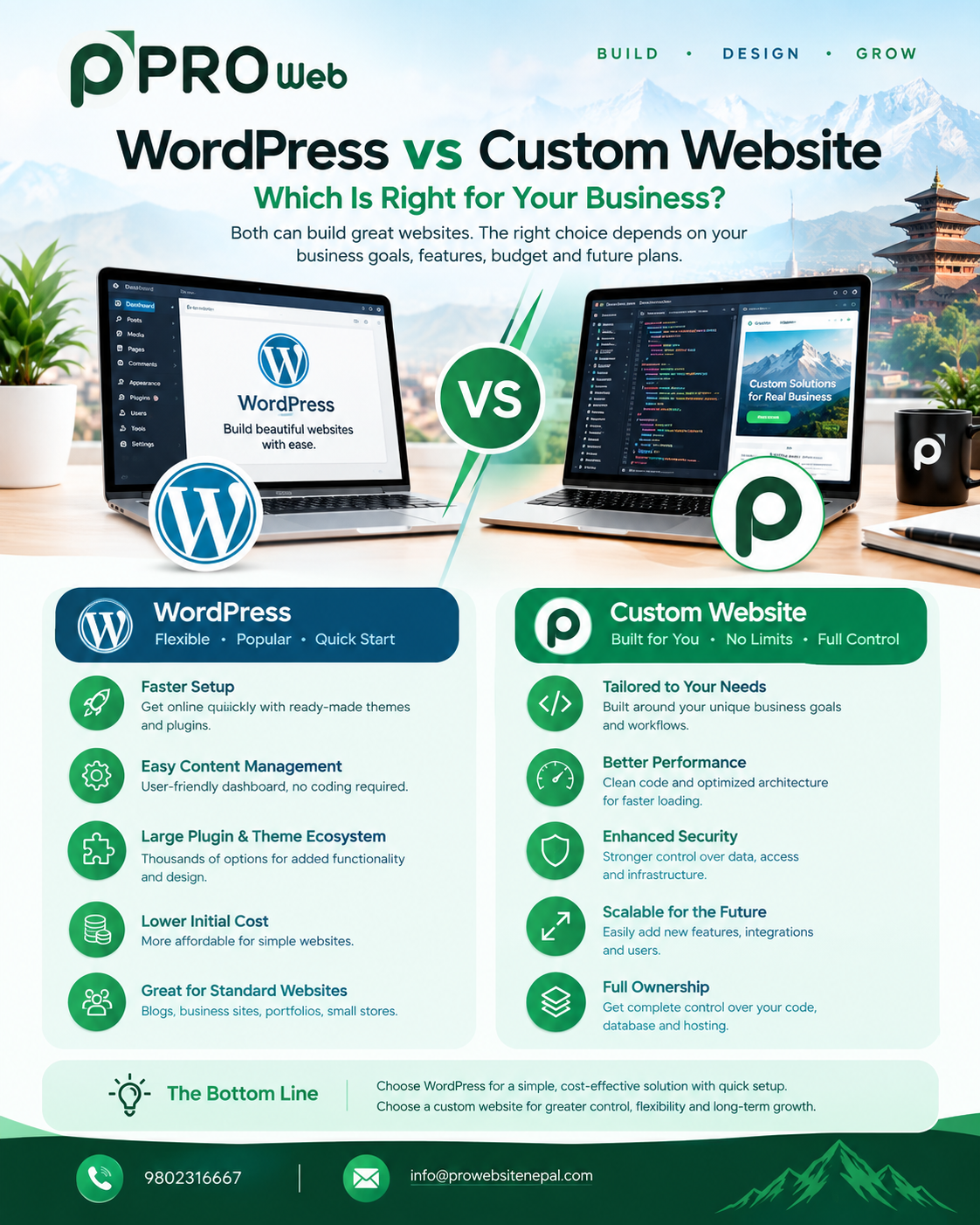
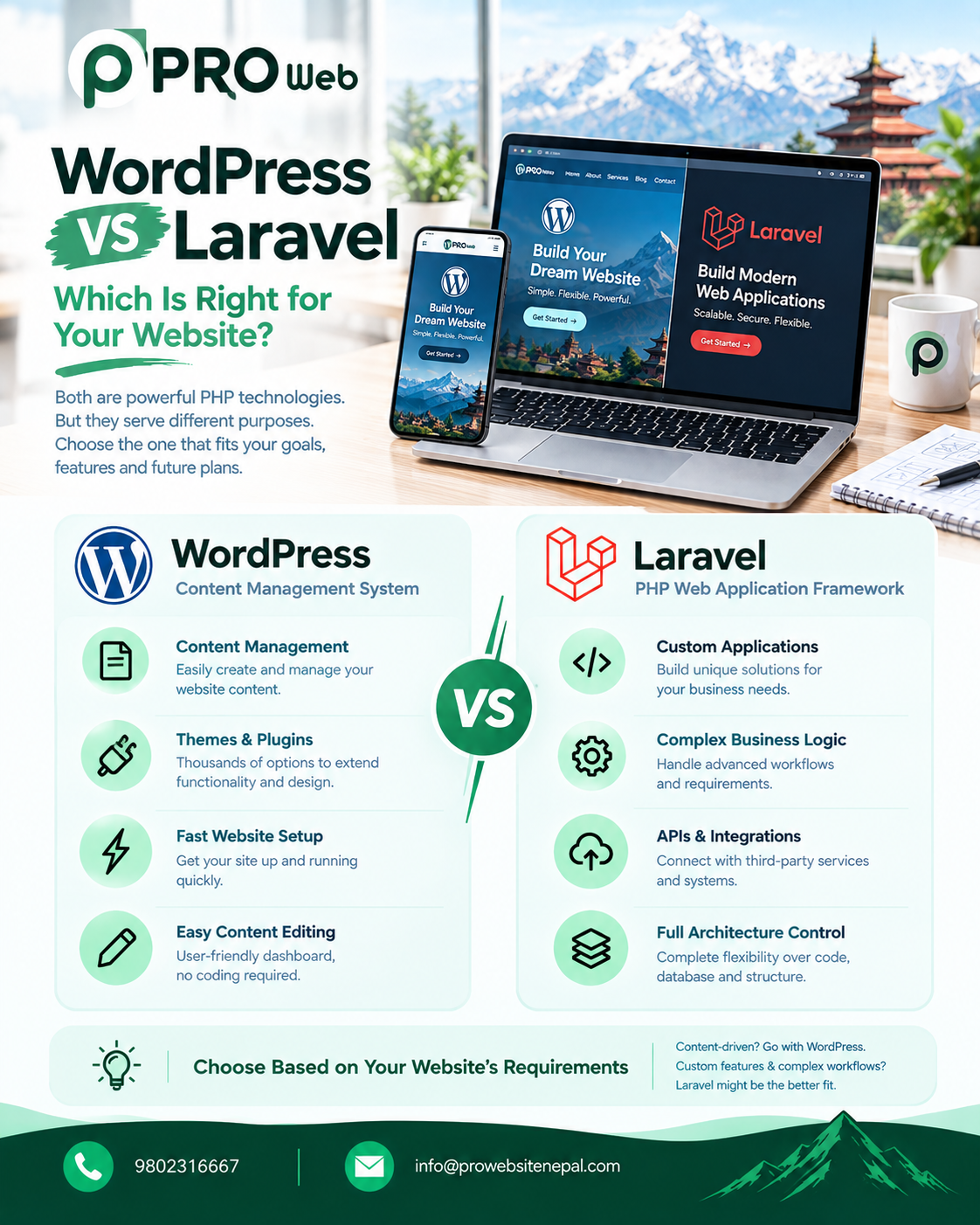
Although both are built around PHP and can be used to create powerful websites, they serve different purposes. WordPress is primarily a content management system (CMS) that provides a ready-made environment for publishing and managing website content. Laravel is a PHP web application framework designed to give developers a structured foundation for building custom web applications and APIs.
Because of this fundamental difference, comparing WordPress and Laravel as if they were identical products can be misleading. The better choice depends on the type of website, required functionality, development approach, content management needs, scalability requirements, and long-term plans.
This guide explains the major differences between WordPress and Laravel and helps businesses understand where each technology fits.
WordPress vs Laravel at a Glance
Factor | WordPress | Laravel |
|---|---|---|
Type | Content Management System | PHP Web Application Framework |
Primary Purpose | Content-driven websites | Custom web applications |
Development | Themes, plugins, custom code | Custom application development |
Content Management | Built in | Must be developed or integrated |
Custom Functionality | Plugins and custom development | Built directly into the application |
Learning Curve | Generally easier for beginners | Requires programming knowledge |
Development Speed | Fast for standard websites | Depends on application complexity |
Design Flexibility | High with themes/custom development | Very high |
Database Control | Available, but WordPress has an established structure | Extensive control over application/database architecture |
Custom Business Logic | Possible | Core strength |
APIs | Available through WordPress features/plugins/custom code | Strong API development capabilities |
Scalability | Can scale with proper architecture | Designed for scalable application development |
Maintenance | WordPress core, themes and plugins | Application dependencies and custom code |
Best Suited For | Blogs, business sites, content websites | Custom platforms and web applications |
What Is WordPress?
WordPress is an open-source content management system built with PHP. It was originally developed around publishing and blogging, but it has evolved into a platform capable of supporting many different types of websites. WordPress describes its mission around publishing and provides an environment that can be used by people with limited technical experience as well as developers who want to customize it extensively.
One of the major characteristics of WordPress is that many common website features are already available.
For example, a WordPress website can provide:
Pages
Blog posts
Categories
Tags
Media management
User accounts
Comments
Navigation menus
Themes
Plugins
Content management interfaces
Instead of developing every one of these features from scratch, developers can configure existing functionality and extend it when necessary.
This makes WordPress particularly useful for businesses that want a website where non-technical users can regularly manage content.
What Is Laravel?
Laravel is a PHP web application framework. Rather than providing a complete website management system out of the box, Laravel provides developers with the architecture and tools needed to build an application. Laravel's official documentation describes it as a framework for web applications and highlights features such as routing, database abstraction, dependency injection, queues, testing, and API backends.
Laravel can be used to build:
Business applications
Customer portals
SaaS platforms
Booking systems
Inventory systems
CRM systems
E-commerce platforms
Dashboards
Membership platforms
REST APIs
Backend systems
Custom management platforms
Laravel can also work as a full-stack framework using Blade, Livewire, or Inertia, or serve as an API backend for applications built with technologies such as React, Vue, or Next.js.
In simple terms:
WordPress gives you a ready-made website management platform.
Laravel gives developers a structured foundation for building a custom web application.
WordPress vs Laravel: The Fundamental Difference
The biggest difference is not programming language.
Both are part of the PHP ecosystem.
The important difference is their purpose.
WordPress
WordPress starts with a functioning content-management environment.
You can install it, choose a theme, add plugins, create pages, and begin publishing content.
Laravel
Laravel starts with a development framework.
You build the application's functionality according to the project's requirements.
This distinction affects almost everything else, including development, customization, maintenance, scalability, and cost.
1. Development Speed
WordPress can be extremely fast for standard websites because many features are already available.
A business website may require:
Home page
About page
Services
Blog
Contact form
Gallery
Testimonials
Basic SEO functionality
Many of these features can be implemented through WordPress's existing functionality and its ecosystem of themes and plugins.
Laravel takes a different approach.
Developers typically create the application's structure, routes, models, database relationships, authentication systems, dashboards, and business logic according to the requirements.
Therefore, Laravel development can involve more initial development work.
However, that additional development can provide a more application-specific architecture.
2. Customization
WordPress can be highly customizable.
Developers can modify themes, create custom themes, develop plugins, add custom post types, modify database interactions, and write custom PHP and JavaScript.
However, the project still exists within the WordPress ecosystem.
Laravel provides a different type of flexibility.
Developers can design the application's architecture around the specific requirements of the project.
For example, suppose a company needs a platform where:
Customers register.
Customers submit applications.
Staff review those applications.
Different departments process them.
Managers approve certain actions.
Customers receive notifications.
The system communicates with another API.
Administrators monitor everything through a dashboard.
This is not simply a content-management problem.
It is an application-development problem.
Laravel can provide the foundation for building such a system around the business's workflow.
3. Content Management
This is one area where WordPress has a fundamental advantage in its intended use case.
WordPress includes a content management interface where users can create and manage content without directly modifying application code.
A typical WordPress administrator can manage:
Pages
Posts
Images
Categories
Tags
Menus
Users
Website settings
Laravel does not automatically provide a WordPress-style CMS.
If you build a Laravel website and want administrators to manage pages, blog posts, products, categories, users, or other content, those systems generally need to be developed or added through appropriate packages and application architecture.
That gives Laravel flexibility, but it also means more development is required.
4. Performance
Performance depends heavily on how the website is built and hosted.
It would be inaccurate to say that every WordPress website is slow or every Laravel application is fast.
A poorly developed Laravel application can perform badly.
A well-optimized WordPress website can perform extremely well.
Similarly, a properly architected Laravel application can be optimized for demanding workloads.
Performance depends on factors such as:
Database queries
Server configuration
Caching
Image optimization
JavaScript and CSS
Hosting infrastructure
Third-party services
Application architecture
Plugins and packages
Traffic patterns
Laravel provides developers with extensive tools for application architecture, caching, queues, database interaction, and other performance-related concerns. Laravel's documentation also describes its scaling capabilities and support for distributed caching systems such as Redis.
WordPress performance often requires careful management of themes, plugins, caching, database queries, and assets.
5. Security
Neither technology automatically guarantees a secure website.
Security depends on implementation, configuration, updates, authentication practices, hosting, dependencies, and ongoing maintenance.
WordPress websites can involve several components:
WordPress core
Themes
Plugins
Hosting
Custom code
Each additional component needs to be maintained appropriately.
Laravel provides developers with a structured application environment and tools for implementing authentication, authorization, validation, database access, encryption, and other application functionality.
However, Laravel does not automatically make an application secure.
Developers still need to follow secure development practices.
6. Scalability
Both technologies can be used for projects that grow over time, but their development models are different.
WordPress can support large and heavily visited websites when properly engineered. Caching, optimized queries, suitable hosting, CDN infrastructure, and careful plugin selection can all contribute to scalability.
Laravel is specifically designed as a web application framework and includes tools that support application development at larger scales. Laravel's documentation discusses horizontal scaling and distributed caching as part of its scaling approach.
Laravel can therefore be particularly useful when scalability involves more than simply serving pages.
For example:
Large numbers of authenticated users
Complex database relationships
Background processing
Queued jobs
API integrations
Real-time functionality
Complex business workflows
7. Database Control
WordPress provides a predefined database structure designed around its content-management model.
Developers can extend WordPress with custom database tables and structures when necessary.
Laravel provides a more application-oriented approach to database development.
Developers can define:
Tables
Relationships
Migrations
Models
Queries
Validation
Business logic
Laravel's Eloquent ORM provides an abstraction layer for interacting with databases.
This can make complex relationships and application-specific data structures easier to organize within a Laravel application's architecture.
8. APIs
WordPress can provide APIs and can be extended to create custom API endpoints.
This makes WordPress useful as a content backend for applications that need to retrieve website content programmatically.
Laravel, however, is frequently used as an API backend for web and mobile applications.
Laravel's official documentation specifically describes using Laravel as an API backend for JavaScript applications such as Next.js.
For example:
Mobile App
     ↓
Laravel API
     ↓
Database
Or:
Next.js Frontend
       ↓
Laravel API
       ↓
MySQL Database
This makes Laravel particularly relevant when the project is more than a traditional content website.
9. E-Commerce
Both WordPress and Laravel can be used to build e-commerce systems.
WordPress commonly uses e-commerce plugins and extensions to provide functionality such as:
Products
Shopping carts
Orders
Payments
Coupons
Shipping
Customer accounts
Laravel can be used to develop an e-commerce platform around specific requirements.
For example, a custom e-commerce system could include:
Custom product structures
Complex pricing
Multiple vendors
Custom order workflows
Warehouse integration
ERP integration
Custom payment systems
Advanced customer roles
External API integrations
The choice therefore depends on whether the project needs an established e-commerce ecosystem or a highly customized commerce application.
10. SEO
Both WordPress and Laravel can produce SEO-friendly websites.
SEO does not automatically come from choosing one technology.
Important SEO factors include:
Page speed
Mobile usability
URL structure
Metadata
Structured data
Internal linking
Sitemap
Crawlability
Canonical URLs
Image optimization
Content quality
Technical architecture
WordPress provides many tools and plugins that make common SEO management accessible to website administrators.
With Laravel, developers have more direct control over how URLs, HTML structures, metadata, schema markup, database-driven content, and application logic are implemented.
For businesses, the important consideration is not simply WordPress vs Laravel for SEO.
The real question is:
How will the website be designed, developed, optimized, and maintained for search engines?
11. Maintenance
WordPress maintenance often involves managing:
WordPress core updates
Theme updates
Plugin updates
PHP compatibility
Security
Backups
Database optimization
Performance
Laravel maintenance has a different focus.
A Laravel project may require:
PHP updates
Laravel framework updates
Composer dependency updates
Application security
Database maintenance
Server configuration
Custom code maintenance
Testing
Deployment management
Both require ongoing maintenance.
The difference is largely in what is being maintained.
12. Learning Curve
WordPress can be accessible to people with limited technical experience because many tasks can be performed through its administrative interface.
Laravel requires considerably more programming knowledge when building applications.
Developers working with Laravel commonly need to understand:
PHP
HTML
CSS
JavaScript
Databases
SQL
MVC concepts
Routing
Controllers
Models
Authentication
APIs
Git
Server deployment
This means Laravel has a steeper learning curve for someone who wants to build applications from scratch.
13. Cost
The technology itself is only one part of website cost.
A project's total cost can depend on:
Design
Development
Features
Integrations
Content
Hosting
Domain
Security
Maintenance
SEO
Third-party services
Development time
A relatively straightforward WordPress website can often be developed quickly because much of the infrastructure already exists.
A custom Laravel application may require more development hours because functionality is created specifically for the project.
However, comparing platforms solely by initial development price can overlook long-term requirements.
A website that needs extensive custom functionality may require significant customization regardless of the platform.
14. Flexibility and Business Logic
This is one of the most important differences.
Imagine a company wants to create a custom employee management system.
The system needs:
Employee registration
Department management
Attendance
Leave requests
Approval workflows
Payroll information
Manager accounts
HR accounts
Notifications
Reports
This is fundamentally an application.
Laravel provides a framework for building the application around those requirements.
WordPress can be extended to perform many custom functions, but the project may become increasingly dependent on plugins and custom WordPress development.
For highly specific business workflows, the application's architecture becomes an important consideration.
15. WordPress vs Laravel for Different Website Types
Website Type | WordPress | Laravel |
|---|---|---|
Blog | Suitable | Possible |
Company Website | Suitable | Possible |
Portfolio | Suitable | Possible |
News Website | Suitable | Possible |
Content Website | Suitable | Possible |
Simple Business Website | Suitable | Possible |
Custom Customer Portal | Possible | Suitable |
SaaS Application | Possible with extensive customization | Suitable |
CRM | Possible with customization | Suitable |
ERP | Possible with extensive customization | Suitable |
Complex Booking System | Possible | Suitable |
Custom API Platform | Possible | Suitable |
Custom Business Management System | Possible | Suitable |
Highly Custom Web Application | Possible with significant development | Suitable |
The table describes common use cases rather than strict limitations. Either technology can be extended beyond these examples.
WordPress vs Laravel: Which One Should a Business Use?
The answer depends on the actual requirements.
WordPress may fit when:
The primary purpose is publishing content.
The website needs an easy-to-use CMS.
Administrators need to frequently create pages and posts.
The project is a conventional business website.
A blog or news section is important.
The project benefits from WordPress's existing ecosystem.
Development needs to move quickly for standard functionality.
Laravel may fit when:
The website behaves more like an application.
The project requires complex business logic.
There are multiple user roles and workflows.
The project needs a custom dashboard.
There are complex database relationships.
Extensive API integration is required.
The application needs custom authentication or authorization rules.
The business needs functionality that does not fit naturally into a conventional CMS.
The project needs a custom backend architecture.
Can WordPress and Laravel Be Used Together?
Yes.
A business does not necessarily have to choose only one technology for an entire digital ecosystem.
For example, a company could use WordPress for its marketing website and Laravel for a separate application.
Marketing Website
       ↓
   WordPress

Customer Application
       ↓
    Laravel

Mobile Application
       ↓
    Laravel API
Another architecture could use WordPress as a content source while a separate application consumes that content through an API.
The appropriate architecture depends on the project's requirements.
WordPress vs Laravel for Custom Website Development
For custom website development, it is important to define what custom actually means.
A WordPress website can be custom-designed.
A developer can create a custom WordPress theme and custom plugins instead of simply installing a pre-made theme.
Likewise, Laravel does not automatically mean that every component has been written from scratch.
Laravel itself provides an established framework and ecosystem.
The distinction is therefore not simply:
WordPress = templates
and
Laravel = custom coding
The reality is more nuanced.
A professional WordPress project can involve substantial custom development, while a Laravel project uses Laravel's existing framework components and packages to accelerate development.
Performance, Flexibility, and Control
When businesses compare these technologies, three concepts frequently appear:
Performance
How efficiently can the website or application process requests and deliver content?
Flexibility
How easily can the system implement unique functionality?
Control
How much control does the development team have over the application's architecture and behavior?
WordPress provides an established content-management environment.
Laravel provides a framework from which developers can construct an application architecture.
Neither concept automatically makes one technology appropriate for every project.
The Importance of the Development Approach
The platform is only one part of the final website.
Two companies could build websites using the same technology and produce completely different results.
For example, performance can vary because of:
Code quality
Hosting
Database structure
Images
JavaScript
CSS
Caching
Third-party integrations
Plugins/packages
Server configuration
Similarly, security depends on how the application is developed and maintained.
This is why businesses should evaluate not only which technology is being used, but also how the website will be designed and developed.
WordPress vs Laravel: A Practical Decision Framework
Before selecting a platform, businesses can ask the following questions:
1. Is the website primarily content-driven?
If the answer is yes, a CMS-oriented platform may be appropriate.
2. Does the project contain complex business processes?
If yes, an application framework may be more suitable.
3. Who will manage the content?
If non-technical employees need to frequently update content, an intuitive CMS can be valuable.
4. Does the website need a custom application?
If users will log in and perform complex actions, the project may need application-oriented architecture.
5. Are there external systems to integrate?
Consider whether the website needs connections with:
Payment gateways
CRMs
ERPs
Accounting systems
Shipping platforms
Mobile applications
External APIs
6. How much custom business logic is required?
The more specialized the business logic becomes, the more important the underlying application architecture becomes.
7. What are the long-term plans?
A website should be designed around both current requirements and realistic future needs.
WordPress vs Laravel for Businesses in Nepal
For businesses in Nepal, the same fundamental considerations apply.
A small company website containing:
Company information
Services
Portfolio
Blog
Contact information
may have very different requirements from a Nepali business developing:
An online booking platform
A customer portal
A logistics platform
A marketplace
A financial management system
A custom CRM
An education platform
A recruitment platform
The technology should therefore be selected according to the project's functionality rather than simply following a technology trend.
How Professional Website Nepal Approaches the Choice
At Professional Website Nepal, website development should begin with understanding the business rather than selecting a technology first.
For content-focused projects, WordPress can provide a practical content-management environment.
For projects requiring extensive custom functionality, a framework such as Laravel can provide a foundation for building the application around the business requirements.
The development approach can focus on:
Clean architecture
Performance
Responsive design
Technical SEO
Security
Scalable development
Custom functionality
API integration
Database optimization
Long-term maintainability
The objective is to select an appropriate technology based on the actual project rather than forcing every business into the same technical solution.
Frequently Asked Questions
Is Laravel better than WordPress?
There is no universal answer because they are designed for different purposes. WordPress is a CMS, while Laravel is a PHP framework for developing web applications. The appropriate choice depends on the project's requirements.
Is WordPress easier than Laravel?
For many standard website tasks, WordPress can be easier for non-developers because it provides an administrative content-management interface. Laravel generally requires programming knowledge for application development.
Can Laravel build a normal business website?
Yes. Laravel can be used to build a traditional business website, including pages, forms, authentication, blogs, and other functionality. However, for a straightforward content-focused website, a CMS may provide more built-in content-management functionality.
Can WordPress build complex web applications?
Yes. WordPress can be extensively customized using plugins, custom themes, custom code, and APIs. However, the complexity of the application should be considered when deciding whether its CMS architecture is appropriate for the project.
Is Laravel good for SEO?
Laravel can be used to build SEO-friendly websites. SEO performance depends on implementation, including technical architecture, page speed, HTML structure, URLs, metadata, structured data, content, and other factors.
Can Laravel be used for APIs?
Yes. Laravel can serve as an API backend for web applications and mobile applications. Laravel's official documentation specifically describes this use case.
Can WordPress and Laravel work together?
Yes. They can be used as separate parts of a larger digital system, or WordPress can provide content through APIs while Laravel powers another application.
Which one costs more?
There is no fixed answer. A basic WordPress project may require less development work, while a Laravel application may require more initial development because functionality is built around specific requirements. Total cost depends on scope, features, design, integrations, hosting, maintenance, and development requirements.
Final Thoughts
WordPress and Laravel should not simply be viewed as competing versions of the same technology.
WordPress is a content management system designed to make publishing and managing website content accessible and extensible.
Laravel is a PHP web application framework designed to give developers a structured foundation for building custom web applications, websites, and APIs.
A content-focused business website may benefit from WordPress's established CMS functionality.
A project centered around complex workflows, custom business logic, APIs, user systems, or application-specific functionality may require a framework-oriented approach such as Laravel.
The most important question is therefore not simply:
“WordPress or Laravel?”
It is:
“What does the business actually need the website or application to do?”
Once those requirements are clear, the appropriate technology and development architecture become much easier to determine.